
Retail 2026: The strategies of the TIME100 Companies leaders you need to know
 Blog
Blog
Share:
The TIME100 Companies: Industry Leaders list is not just a ranking of brands, it is a compilation of the business strategies that are currently most important in retail: from conversational commerce and AI, through the digitalisation of brick-and-mortar stores, to resale, rental and experience-based retail. It offers guidance for entrepreneurs on how to operate so as not to fall behind and to keep pace with market leaders.
Key insights
- TIME has identified the 10 most influential companies in the retail sector for 2026, and the common thread running through this list is the combination of technology with convenience, flexibility and a stronger customer experience.
- The list clearly shows the growing importance of AI in retail, particularly in the areas of demand forecasting, conversational commerce, delivery automation and improving operational accuracy.
- At the same time, the importance of the physical shop is also growing, but in a new form: one that is much more experience-based and integrated with data.
- Models based on circularity, rental and resale (rather than the ‘make, buy, throw away’ model) are becoming increasingly important, as are brands that drive growth through loyalty and community.
– From a retailer’s perspective, this list is valuable not only because it highlights the brands currently at the top of their game, but above all because it clearly reveals the trends shaping the retail sector – from AI and automation to new shopping experience formats – says Dariusz Stolarczyk, Strategic Advisor at Exorigo-Upos – It clearly shows that today’s market leaders are companies that can combine technologies, such as electronic price tags, with operational efficiency and a better understanding of the customer.
What does the TIME100 Companies list tell retailers?
TIME magazine has unveiled its TIME100 Companies: Industry Leaders list. This is an extension of the main ranking of the most influential companies, highlighting the 10 firms set to shape the retail industry most significantly in 2026. Among them are: Quince, Vusion, Barnes & Noble, Back Market, Warby Parker, Whatnot, DoorDash, Nuuly, Jellycat and Shopify. The very selection of these companies shows that retail is not developing in a single direction today, but in several parallel ones simultaneously.
The list of market leaders does not present the largest companies, but above all the most influential business models. When looking at the retail sector today, one must pay attention not only to the size of the business, but also to how leaders combine technology, operations, data and the customer experience.
Why is AI becoming an integral part of the retail sales model?
This is one of the key takeaways from the TIME100 Companies: Industry Leaders list – AI is no longer merely an innovative add-on, but a tool that supports specific retail sectors. For example, Quince uses AI to forecast demand, which underpins its model of rapid product testing and maintaining competitive prices.
The number of AI-driven orders on Shopify, a global e-commerce platform, has increased 15-fold since January 2025. DoorDash is implementing AI both on its autonomous delivery platform and in its SmartScale solution, which reduces the number of missing items in orders by up to 30%. Meanwhile, Warby Parker has announced the launch of AI-powered glasses, developed in collaboration with Google.
From a retailer’s perspective, this means one thing: AI is having an increasingly direct impact on sales, logistics and customer service, rather than just on ‘back-office’ analytics. This is a significant shift. The market leaders will be those companies that can implement AI into the customer journey and day-to-day operational processes.
Are brick-and-mortars making a comeback?
Yes, but in a different role. The TIME article also highlights another trend very clearly: physical shops aren’t disappearing from the market, they’re simply changing their function. Barnes & Noble has returned to a growth trajectory by focusing on its core category – books – and giving store staff greater autonomy in curating the product range, creating displays and responding to trends. The chain opened around 60 new stores in the US in 2025 and planned a similar number for 2026.
Warby Parker is rapidly expanding its network of over 330 stores and testing a shop-in-shop format within Target stores. The brand emphasises maximum convenience, which is intended to set its customer journey apart from the competition. Back Market, meanwhile, has opened its first physical store in Manhattan so that customers can physically test the devices they are buying.
The physical store is once again becoming a strategic asset, but not in its traditional form, rather as a place for experiencing, testing, building trust and finalising purchasing decisions. Retailers who view physical stores solely as points of sale will find themselves far behind the competition.
How does store digitalisation affect pricing and operations?
One of the companies mentioned in the report is Vusion, one of the leaders in the global electronic price label (ESL) market. The company reported $1.79 billion in revenue in 2025, up 51% year-over-year.
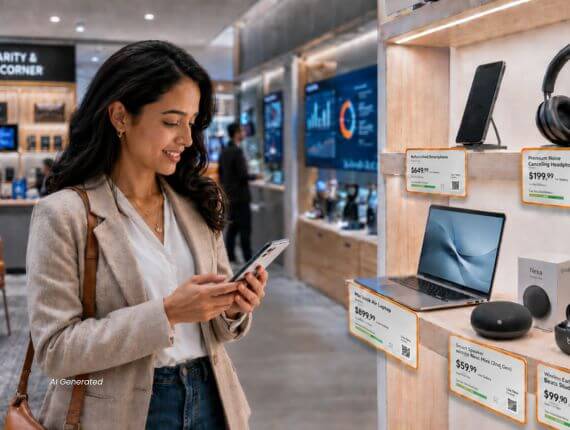
Exorigo-Upos’ Shelf Edge solution proves that electronic price tags (ESLs) are more than just an improvement on paper price tags. It is a comprehensive approach to price communication in the store, combining the NetTickIT system with modern ESL screens. Such synergy makes them a key element of the digitization of trade – not only in the context of pricing, but also in the context of product availability, promotion and data consistency.
The new generation of high-street shops is set to be fully automated and data-driven, whilst offering consumers an engaging, personalised shopping experience.
New consumption models: resale, rental and affordable luxur
Quince is developing an affordable luxury model, combining lower prices with transparency and direct collaboration with factories. Back Market is emerging as a powerhouse in the refurbished electronics sector; in 2025, the total value of goods sold on the platform reached $3.5 billion – a staggering 32% increase on the previous year.
Nuuly, meanwhile, demonstrates that fashion rental can be more than just a niche experiment; it can be a scalable business. The platform had nearly 400,000 active subscribers, grew by 53% year-on-year, and was expected to exceed $500 million in annual revenue by 2026.
These examples demonstrate that, in the new market reality, the pursuit of novelty is giving way to flexibility and economic pragmatism, which is becoming a key driver of customer purchasing decisions.
Of course, this does not necessarily mean that every brand should enter the resale or rental market. However, it does mean that it is worth analysing where, within a given category, the importance of more flexible, circular models based on a longer product lifecycle is growing.
Are social commerce and live commerce still growing?
Yes, and a TIME article illustrates this using the example of Whatnot. This platform combines livestream shopping with auction and social elements, and users spend an average of 95 minutes a day on it. This is similar to the time the average user spends browsing TikTok. Whatnot also emphasises that it supports small businesses, and one in eight sellers has turned their activity on the platform into a full-time job.
This is an important signal for retailers: sales are increasingly taking place in environments where customers can view, interact, respond and purchase all at the same time. Content, community and transaction are increasingly becoming a single experience. This is changing not only marketing, but also the way we think about product range, availability and responsiveness.
How important is the retail experience today?
Enormously so, as the example of Jellycat clearly shows. TIME describes the brand as a company that no longer sells just soft toys, but builds entire worlds and experiences around them. Jellycat’s shops and displays become part of the brand’s narrative. The company collaborates with over 7,000 retailers in 80 countries, and its sales have risen from just $7 million in 2013 to $252 million in 2023, reaching as much as $446 million the following year.
This is an important lesson for the market – customer experience is no longer solely a function of UX in e-commerce, but also a way of shaping engagement with the brand in the physical world. Retailers who can create emotional, memorable moments gain an advantage that is difficult to achieve by relying solely on price promotions, for example.
Summary: What does all this mean for retailers?
The TIME100 Companies list for retail shows that the future of retail will belong to companies that can combine AI, operational efficiency, a digital storefront and a strong customer experience. It is no longer a question of choosing between offline and online, technology and emotion, or price and convenience. The retailers who will succeed are those who learn to combine these elements into a single, coherent operating model, whilst ensuring cybersecurity.
Retail in 2026 is not following a single path. The TIME100 Companies: Industry Leaders list shows that the importance of AI, conversational commerce, operational automation, in-store digitalisation, retail experience, and circular and subscription models is growing in parallel. The common denominator, however, is clear: the companies that succeed are those that respond better than others to the following customer needs – convenience, trust and the relevance of the offering.