
In-Store Retail Media: How does a shelf screen replace a flyer?
 Blog
Blog
Share:
The most important information from the article:
- Shelf screens increase sales through contextual communication at the time of a purchase decision.
- Retail media in a physical store is more measurable than traditional flyers.
- Dynamic content allows you to react to inventory, promotions and customer profiles.
- Technology solutions, such as those developed by Exorigo-Upos, integrate sales, payments, and marketing communications.
- Paper-based POS materials are gradually being replaced by digital, scalable, and eco-friendly alternatives.
Is the era of paper leaflets in retail coming to an end? The answer is not yet, but it may be a matter of time.
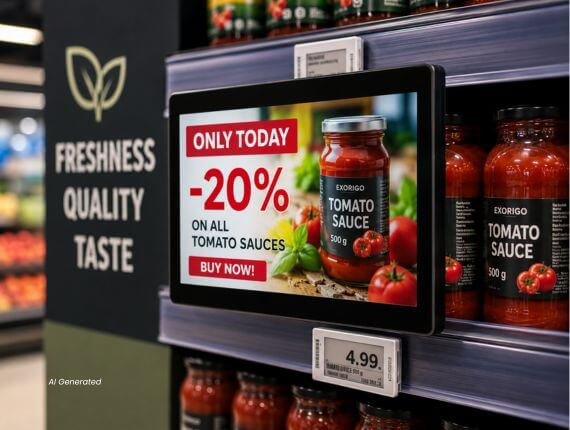
Shelf screens replace traditional media because they offer dynamism, savings in operating costs and a unique ability to target content at the point of sale. Thanks to the solutions implemented by Exorigo-Upos, retail chains can now manage communication across thousands of screens from one place, thus providing customers with content that cannot be “scrolled” past or thrown in the trash.
What is In-Store Retail Media?
In-Store Retail Media is the use of digital advertising in a physical store – screens, electronic labels, or kiosks – for marketing communication with customers.
The system is based on several elements:
- digital signage screens,
- content management software,
- integration with the sales system (POS),
- analysis of purchase data.
What are the best examples of In-Store Retail Media use?
- the product starts to sell out → the system automatically turns off the promotion;
- excess goods → the screen promotes the product more intensively;
- Peak hours → announcements are shortened and focused on bestsellers.
Thanks to this, retail chains gain:
- communication with customers at the point of purchase,
- the ability to target content,
- integration with sales systems,
- full measurability of effects.
What does the screen at the shelf offer that the leaflet does not give?
A screen is not just a carrier of information – it is a sales tool. Therefore, in many aspects, it gains an advantage over paper labels. These are m.in:
- dynamic content – changes depending on the time of day, promotion or product availability,
- better visibility – movement and light attract attention,
- shopping context – the message appears exactly next to the product,
- integration with data – the system knows what is selling and reacts,
- automation – no need to manually change materials.
Screen vs. leaflet – comparison
| Feature | Paper leaflet | Shelf screen |
| Update | Manual | Automatic |
| Personalization | None | Possible |
| Long-term cost | High | Lower |
| Measurability | Limited | Full |
| Environmental impact | Negative | Limited |
| Visual appeal | Low | High |
Can screens by the shelf build customer loyalty?
The modern consumer, especially from Generation Z and Alpha, expects modernity from stores. Static, often crumpled or outdated leaflets build the image of an “analogue” brand. Digital screens, properly integrated with the store’s mobile app, create a consistent omnichannel experience.
How does Exorigo-Upos support the digital transformation of stores?
The process of switching from paper to digital media requires not only hardware, but above all stable software and service. Exorigo-Upos offers a comprehensive approach: from the audit of the store space, through the selection of appropriate high-brightness matrices (important for strong store lighting), to content management systems (CMS).
Thanks to the cooperation with Exorigo-Upos, retail chains do not have to worry about the technical aspects. The company ensures that content is displayed smoothly and that any failures are quickly diagnosed remotely, which guarantees the continuity of marketing communications.