
Customers Don’t Choose Channels – They Choose Convenience: Key Trends in Polish Retail for 2026
 Blog
Blog
Share:
The latest report, “Omni-commerce. Shopping Conveniently 2026,” prepared by Mobile Institute for the Polish Chamber of Digital Economy (e-Izba), shows that consumers are shopping more often, moving fluidly between sales channels, becoming increasingly comfortable with artificial intelligence in the purchasing process, and placing convenience above all else. For the industry, the message is clear: competitive advantage is no longer built through a single channel, but by delivering a consistent customer experience.
Key insights
- 93% of internet users made an online purchase in the past six months, while 100% have bought something online at least once.
- 42% of consumers shop online five or more times a month, meaning market growth is being driven by higher purchase frequency rather than an influx of new buyers.
- 64% of respondents shop on mobile devices, and as many as 94% use apps during online shopping.
- 65% of consumers buy the same brands across different channels, while the share of purchases completed entirely within a single channel has fallen from 45% to 39%.
- 63% of respondents allowed an AI assistant to search for and recommend a product independently.
- Social commerce and cross-border shopping are clearly gaining importance.
– The report “Omni-commerce. Shopping Conveniently 2026” sends a clear message: consumers do not prefer particular channels – they prefer convenience, – says Dariusz Stolarczyk, Strategic Advisor at Exorigo-Upos – The companies most likely to succeed will be those that combine e-commerce, m-commerce, physical stores, logistics, and payments into one coherent model while preparing for the growing role of AI in purchasing decisions.
Why is omni-commerce more important today than e-commerce alone?
E-commerce itself is no longer a differentiator. It is now a mature and saturated market: 100% of internet users have made at least one online purchase, and 93% bought online within the past six months. What is more, 79% of respondents completed their most recent purchase digitally, while only 21% did so in a physical store.
Further e-commerce growth is no longer determined primarily by attracting new customers, but by how often existing customers shop online, how smoothly they move between channels, and how convenient the entire purchasing experience is.
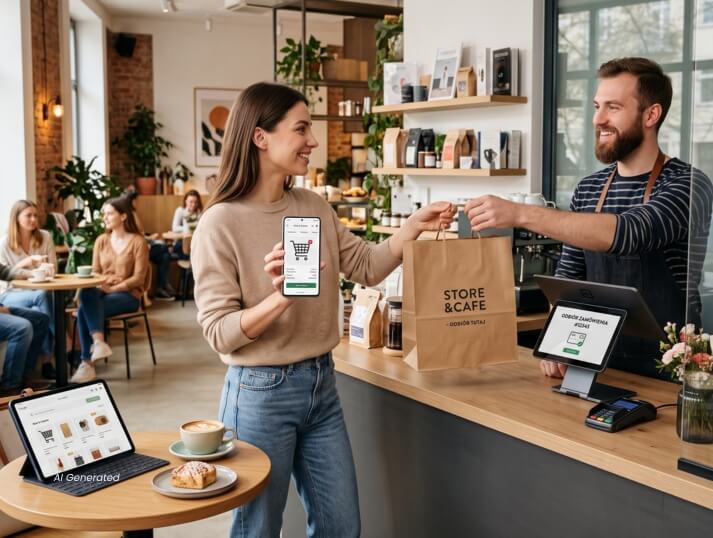
This is precisely why omni-commerce is gaining so much importance. Consumers no longer treat online, mobile, and offline as separate worlds. What matters is whether they can quickly find a product, compare offers, pay without friction, collect an order in the most convenient way, and return easily to the brand for their next purchase.
From a retail perspective, this means viewing the sales process as a single customer ecosystem rather than a collection of separate channels.
From fashion to e-grocery: Polish e-commerce has reached maturity
Polish e-commerce is already a mature market, but maturity is not only about high online shopping penetration. It is also about regularity. A growing group of consumers shop online several times a month: 42% now make at least five online purchases monthly, 8 percentage points more than a year earlier. Digital commerce is also winning beyond categories with a long-established online presence, such as electronics and fashion.
E-grocery is growing especially quickly: 60% of internet users now buy food products online, up 8 percentage points year on year. Pharmaceutical products are expanding even faster, with the share of online buyers rising by 11 percentage points to 46%. Online channels are therefore increasingly taking over everyday purchases. This raises the importance of logistics, product availability, product data quality, and mechanisms that encourage customers to return.
Consumers are also using more shopping channels than before, while social media have evolved from a source of inspiration into an increasingly important place to buy products.
Why has convenience become the most important value in retail?
In a highly saturated market, customers compare not only prices but the entire shopping experience. The benefits of online shopping highlighted most strongly in “Omni-commerce. Shopping Conveniently 2026” include:
- 24/7 availability;
- attractive promotions;
- the convenience of shopping from anywhere;
- a wide product selection;
- easy comparison of offers;
- better pricing conditions.
Price remains important, but it is increasingly insufficient to close a sale on its own. If the purchasing process is too long or inconvenient, delivery options do not match customer preferences, or payment requires too many steps, a price advantage may not be enough. An omni-commerce strategy should be built not only around technology, but also around improving the customer experience. Success will belong not only to retailers with a strong offer, but to those that can:
- move customers towards purchase completion more quickly;
- simplify checkout;
- provide freedom of delivery choice;
- ensure consistency across channels;
- maintain the customer’s sense of control throughout the purchasing process.
What role does m-commerce play today, and why can retailers no longer treat it as secondary?
M-commerce is now one of the pillars of sales: 64% of Polish consumers have made a purchase using a mobile device. Smartphones are no longer used only for browsing products; they are increasingly used to complete purchases, track deliveries, access promotions, and manage relationships with brands.
This is even clearer in the case of mobile apps. During online shopping, 94% of consumers use them. They value apps as a faster shopping tool, appreciating saved data, simplified payments, dedicated offers, and features unavailable in standard web browsers. The message for the industry is clear: an app should not merely replicate an online store, but offer a significantly more convenient and personalised shopping environment.
At the same time, some companies are still not properly adapted to mobile shopping. This remains one of the most frequently cited reasons why consumers do not buy more often via smartphone. There can be no modern omni-commerce without a seamless mobile experience.
Do customers really shop across multiple channels today?
Yes. Buying the same brands and products sometimes online, sometimes via mobile, and sometimes in a physical store has become natural behaviour for many consumers. They want the freedom to move between channels and choose whichever option is most convenient or cost-effective at a given moment.
At the same time, the share of purchases completed entirely within one channel is falling. Customers increasingly search in one place, compare in another, and buy in a third. This is especially visible in e-grocery: the number of consumers who begin buying food products offline and complete the purchase online has increased by 28 percentage points. As a result, behaviours such as the following are becoming increasingly important:
- ROPO;
- reverse ROPO;
- showrooming;
- online trigger.
Physical stores, e-commerce, apps, and social media do not compete with one another; they work together within a single customer journey. Retail therefore needs:
- consistent customer data across channels;
- the same quality of offer and communication at every customer touchpoint;
- fast checkout;
- the ability to complete a purchase in the customer’s preferred channel.
Purchases are still completed mainly in online stores, but increasingly also in shopping apps and on social media. Social media are no longer only a source of inspiration and reach, they are becoming a fully fledged sales channel. The report also indicates that social platforms and shopping apps will increasingly compete at the transaction stage, not only at the awareness stage.
What is changing in delivery, and why is click-and-collect growing so quickly?
Delivery is becoming part of competitive advantage, and consumer preferences in this area are becoming increasingly diverse. Parcel lockers remain the leading option, but click-and-collect, pickup points, and in-store collection are clearly gaining importance. The share of consumers using click-and-collect increased by 12 percentage points in one year.
A physical store should now serve not only as a sales location, but also as a logistics hub. Click-and-collect gives customers flexibility in choosing when and where to collect their order, often at a lower cost, while allowing brands to use their existing infrastructure more efficiently. Growing interest in this model shows that consumers value control over collection rather than one single dominant delivery method.
For retailers, this means offering a broad choice of delivery options, integrating with logistics operators, and ensuring close cooperation between e-commerce and physical stores.
How do customers want to pay, and why is payment becoming part of the shopping experience?
Payment is now a crucial part of the sales process because it can determine whether a customer completes a purchase or abandons the basket. Consumers want convenience and mobile payment options, which is reflected in the growing popularity of:
- digital wallets;
- stored cards;
- payments integrated into apps;
- solutions requiring as few steps as possible.
BLIK remains the most frequently used online payment method, but its share is declining, as is the use of card payments that require users to enter details manually. Digital wallets, by contrast, are gaining ground. Customers want to pay quickly and efficiently: the fewer steps, fields, and screen changes involved, the greater the chance of completing the transaction.
Is AI really beginning to influence consumer purchasing decisions?
Yes, and this may be one of the biggest changes in Polish e-commerce. AI is no longer relevant only on the retailer’s side as a technology platform or marketing tool; it is becoming an important participant in the customer’s shopping process. Consumers use AI to search for, compare, and select products, and a significant share allow AI assistants to recommend the best option independently.
For retail, this is a strategic shift. For years, search engines, marketplaces, comparison sites, and social media competed for traffic. Now AI-generated answers and recommendations are becoming increasingly important. Competition for customer attention may therefore move towards visibility in AI recommendations, high-quality product data, and the ability of a brand to be understood and selected by digital assistants.
This is another argument for coherent omni-commerce. If a company provides inconsistent product information, a weak mobile offer, an inconvenient checkout, or limited delivery options, AI may not only fail to support its sales but may also direct the consumer to a better-prepared competitor. This is why a robust PIM system, such as PIM Box, is so important in retail.
Why are social commerce and recommerce no longer niche markets?
Because they respond to current customer needs. Social commerce is growing because it shortens the path from inspiration to purchase. Users no longer need to leave the environment in which they consume content in order to buy a product. This naturally strengthens the role of social platforms as sales channels.
Recommerce is growing not only because of interest in responsible consumption, but also for purely economic reasons. Buying used products is no longer niche behaviour. For many consumers, it is a way to manage their budget more rationally. From a retail perspective, recommerce is beginning to affect not only sales, but also logistics, returns, pricing policy, and customer lifetime value models.
Brands seeking growth in the coming years should monitor both areas closely. Social commerce and recommerce will not be essential for every business model, but in many categories they will increasingly influence customer expectations.
What does the report say about cross-border shopping and competition from outside the EU?
Cross-border shopping has increased its share since 2022, and a large proportion of consumers buying internationally use platforms and stores based outside the European Union.
Price remains crucial for this group, but communication about delivery and shipment status is becoming increasingly important.
Customers buying abroad expect clear messages and accurate shipment updates, while their communication preferences are shifting strongly towards in-app notifications. For retailers, this is a practical lesson: in cross-border commerce, the offer alone is no longer enough; transparency throughout order fulfilment matters as well.
For Polish brands, this creates two challenges. First, they need to compete more effectively on convenience and predictability, not only on price. Second, they should build advantage where global platforms are often weaker: customer service quality, credibility, simple returns, local customer understanding, and well-designed post-purchase communication.
What should a retailer do to succeed in the near future?
The priority today is to think of commerce as a coherent experience rather than a collection of channels. The report points to several priorities for retailers:
- increase purchase frequency rather than focusing only on acquiring new customers;
- develop m-commerce and apps, as mobile is becoming the centre of everyday shopping;
- connect online and offline, particularly in logistics and click-and-collect;
- simplify payments to reduce customer effort;
- prepare for AI, which is increasingly influencing product choice;
- improve post-purchase communication, especially in delivery and cross-border sales.
Summary
“Omni-commerce. Shopping Conveniently 2026” shows that Polish retail is entering a new stage of maturity. Consumers move more freely between channels, rely more heavily on mobile, accept and use AI, and increasingly expect convenience at every stage of the purchase. For retailers, the conclusion is clear: being present in e-commerce is no longer enough. The entire omni-commerce experience must be designed to be simple, consistent, and genuinely convenient. The organisations most likely to succeed will be those that connect sales, data, logistics, payments, and customer experience into one efficient operating model.