
Handel detaliczny artykułami spożywczymi 2026 w Europie: marże pod presją, marki własne w ofensywie i AI na progu przełomu
 Blog
Blog
Share:
Although the European grocery retail sector enters 2026 in a phase of stabilization, the market environment remains far from comfortable. Sales growth is sluggish, margins are under continued pressure, and consumers are increasingly diversifying their needs – balancing the search for value with a demand for quality and convenience. According to the McKinsey & Company report, “The State of Grocery Retail Europe 2026,” retailers who combine cost discipline, strong private labels, and a pragmatic approach to AI will gain the competitive edge.
Key insights:
- Grocery sales in Europe grew by 3.4% in 2025, but volume growth remained at just 0.6%, indicating that the market continues to develop at a very moderate pace.
- Private labels now account for 40% of the market by value and are no longer associated solely with low prices; they are increasingly asserting their presence in the quality and innovation segments.
- 77% of CEOs surveyed identify cost and margin pressure as their top priority, with AI and automation rising to the second spot on the industry’s agenda.
- AI holds strategic significance for retailers today, but most firms have yet to translate implementations into bottom-line results: 70% of CEOs surveyed have not yet seen a measurable impact of AI on EBIT, or believe it is too early to evaluate.
– For grocery retailers, 2026 will be a test of their ability to quickly adapt their operating models to market demands – says Marek Nowakowski, Business Development Manager at Exorigo-Upos – Winners will be those who streamline costs, better address polarized consumer needs, and select technology investments that genuinely support margins and productivity.
Why is European grocery retail still under pressure?
Because stabilization does not equal a return to prosperity. The “The State of Grocery Retail Europe 2026” report shows that while 2025 halted extreme volatility, pressure on profitability remains intense. The 3.4% sales growth was driven primarily by food price inflation (2.9%) rather than increased volume demand.
Consequently, real-terms sales remain approximately 3.3% below 2019 levels. This means retailers can no longer rely solely on favorable market conditions. They must seek an edge within their own operating models: through productivity, improved product mix, and more effective responses to evolving consumer needs.
How is the grocery consumer in Europe changing?
The European grocery consumer is becoming increasingly heterogeneous. The McKinsey & Company report clearly indicates a shift away from universal shopping patterns toward strong polarization. Consumers increasingly seek discount pricing for staple products while simultaneously investing in quality, convenience, or ethics in selected categories. Their choices are now a result of both wallet share and individual, often conflicting, expectations toward the brand.
Price pressure is gradually easing, but the process is uneven. Low-income households remain highly intent on saving and hunting for promotions, while higher-income segments increasingly gravitate toward premium and high-quality products. A single pricing policy and uniform marketing message are no longer sufficient. The future lies in precise cohort strategies tailored to specific needs: distinct approaches for the budget-conscious versus those prioritizing quality, convenience, or health.
Is convenience really winning over home cooking?
Increasingly so – especially among younger generations. The “The State of Grocery Retail Europe 2026” report finds that the foodservice segment is growing faster than traditional grocery retail, with a 2-percentage-point difference in growth dynamics. The popularity of ready-to-eat meals is particularly visible among Gen Z: 82% purchase them at least once a month, and 47% at least once a week. Millennials remain another strong driver of this trend.
For grocery retailers, this is not a niche trend but a concrete growth area. Chains are dynamically expanding their ready-to-eat offerings, food-to-go formats, hot food counters, and convenience zones. The line between grocery and foodservice is blurring, opening new opportunities to increase visit frequency and basket value.
What truly builds an advantage today – price or private label?
The report suggests it is increasingly a private label. Private label’s share of the European market has grown to 40% of sales value, and its growth is no longer based on price alone. Today, private labels are boldly entering premium, bio, local, and free-from segments, while also focusing on innovation-led assortment. Furthermore, in Western Europe, they already account for 44% of all new product launches in grocery, with that figure reaching up to 70% in food categories alone.
This is critical for retailers. The report shows that in recent years, the quality and breadth of private label offerings were more important factors in gaining market share than price alone. In other words, private label has ceased to be merely a tool for margin protection; it is increasingly becoming a tool for real format differentiation and loyalty building.
Why is diversifying revenue sources (beyond the basket) becoming a priority?
Organic growth in core categories will be structurally limited in the coming years. Projections indicate that the CAGR of grocery volume in Europe will reach just 0.2% by 2030, and the era of intensive store footprint expansion has passed.
For retailers, this means a necessity to look beyond traditional business models to improve EBIT. The report points to retail media as a key opportunity—a model that leverages existing traffic and first-party data to create high-margin services with relatively low capital intensity. Scaling the business no longer needs to rely solely on opening new stores or engaging in price wars.
What is the current role of AI in grocery retail?
Strategically, the role of AI is growing dynamically, although its operational impact on financial performance remains limited. While 47% of CEOs list AI and automation as one of their top three priorities, 70% have yet to see a measurable impact on EBIT, or feel it is too early to judge.
Digital maturity data confirms this: 83% of grocery retailers are currently only building their AI competencies or are in the early stages of their AI strategies. The most important areas where AI can transform grocery retail are:
- Agentic commerce – the impact of AI on how customers search, compare, and purchase;
- Agentic organization – the restructuring of internal processes;
- Physical AI – the automation of goods flow in warehouses, backrooms, and increasingly, in the store environment.
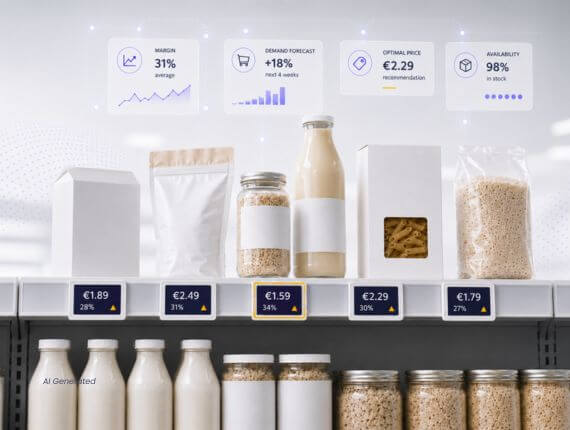
AI cannot remain a collection of isolated experiments. Implementations must be tied directly to measurable business outcomes: increased productivity, margin improvement, optimized pricing, more efficient replenishment, or faster promotion planning.
What does the report recommend for retailers in 2026?
In short: a dual agenda. First, it is necessary to strengthen the core business: simplify organizational structures, improve workforce planning, reduce SG&A, increase productivity, and build lasting advantages through private labels. Second, retailers should selectively scale those adjacencies that can realistically generate additional EBIT without overcomplicating operations.
The report emphasizes that retailers should specifically:
- better monetize polarized demand through strategies tailored to different customer cohorts;
- develop convenience and ready-to-eat formats;
- treat product data, pricing, and availability as the key to visibility in agentic commerce;
- measure technological ROI more maturely, going beyond the evaluation of individual projects.
Summary
The European grocery retail market in 2026 no longer offers easy growth opportunities. Faced with polarized consumer attitudes and cost pressures, success will depend on effectiveness in three areas: building a unique private label offering, maximizing the potential of convenience formats, and maintaining a disciplined approach to technology implementation. Rather than waiting passively, retailers must now actively define their business models to succeed in an increasingly challenging market.