
Electronic Shelf Labels and Algorithms. How AI is Transforming Retail Pricing Strategies
 Blog
Blog
Share:
The surge in interest surrounding artificial intelligence has sparked a discussion in the North American market regarding so-called surveillance pricing – a theory suggesting that algorithms could optimize prices in real-time based on individual consumer profiles. Proposed implementations of this type across retail chains in Canada and the US are triggering regulatory debates and customer concerns about transaction transparency. Experts at Exorigo-Upos reassure: in the European market, AI-driven pricing transformation based on Electronic Shelf Label (ESL) systems primarily serves to build trust and operational efficiency, rather than hidden manipulation.
AI-based price management is one of the fastest-growing trends in global retail. However, considerable misunderstanding has developed around the topic, stemming mainly from a confusion of concepts. Consumers often fear that AI will lead to intraday price fluctuations right on the store shelves. In reality, the role of algorithms in retail lies not in continuous and speculative shelf-tag manipulation, but in optimizing operational processes.
“Consumer concerns regarding dynamic pricing often stem from a failure to distinguish base-price personalization from operational automation. Under European market realities, the priority for retail chains is not hidden customer segmentation at the shelf edge, but ensuring data consistency and optimizing labor costs,” comments Dariusz Stolarczyk, Strategic Advisor at Exorigo-Upos.
The European retail market operates under a regulatory framework that effectively prevents discriminatory pricing practices. Key among these are the regulations of the EU Omnibus Directive and GDPR. Any attempt to automatically adjust a base price to an individual consumer profile would require meeting strict information requirements, including explicitly stating that the price has been personalized based on automated decision-making. In Europe, offer customization is executed transparently through loyalty programs and dedicated apps, while shelf prices remain uniform for all market participants.
Therefore, the rollout of ESL systems by retail chains in Poland and across the region is not driven by a desire for dynamic price diversification, but rather by the need to boost operational efficiency and adhere to applicable regulations. The scale of challenges related to accurate price display is evidenced by data from regulatory authorities such as Poland’s UOKiK (Office of Competition and Consumer Protection) and Romania’s consumer protection agency, ANPC. In 2025, the Polish Trade Inspection, acting on behalf of UOKiK, conducted a large-scale audit across more than 3,000 locations—ranging from major retail chains and petrol stations to small service points. Inspectors checked price markings for 461,437 products and identified non-compliance issues at nearly half of the businesses. The most common infractions involved missing prices, promotional manipulation, and unclear information for customers. Similarly, Romania’s consumer protection agency audited nearly 250 stores of major retail chains last year. Non-compliance was found in almost 99% of locations, with only four stores recording zero violations. Romanian inspectors most frequently registered discrepancies between shelf prices and POS checkout charges, expired products, and misleading labels.
“Electronic shelf labels effectively eliminate key retail challenges, starting with discrepancies between shelf pricing and POS checkout rates—a frequent trigger for fines imposed by authorities like Poland’s UOKiK or Romania’s ANPC. Integrating ESL systems with a central database gives retailers 100% real-time data consistency. Automation also removes time-consuming, manual paper tag replacements, allowing staff to spend more time on direct customer service,” explains Marek Nowakowski, General Director of Exorigo-Upos SRL Romania, adding: “Despite the benefits of ESL, a hybrid approach is often seen in Polish stores, where part of the inventory is labeled digitally and part traditionally, which can lead to discrepancies. Avoiding this requires a single source of pricing truth to maintain full data consistency regardless of format. Fortunately, solutions exist. Specialized edge-management software, such as NetTickIT, enables smooth control over this process.“
Shelf Edge Management: Integrating ESL Systems with Modern Software
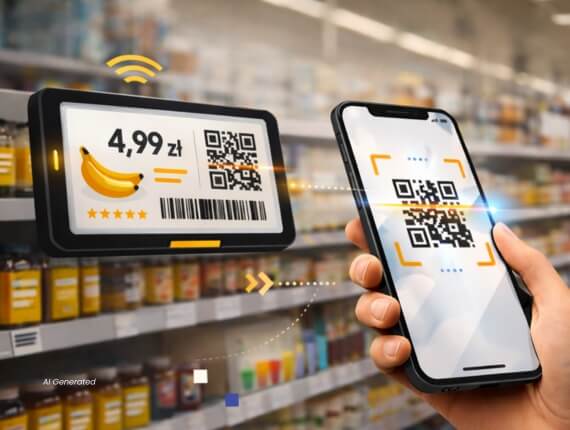
Automating price communication at the point of sale now extends far beyond replacing paper with digital displays. The key to success lies in effectively managing information rendered at the shelf edge—the direct touchpoint between customer, product, and brand.
To ensure this area runs reliably and in full compliance with legal requirements, display hardware – including Electronic Shelf Labels (ESL) – requires an intelligent backend engine in the form of specialized shelf edge management software. Designed to tackle these challenges, platforms like NetTickIT enable centralized, real-time, zero-error control over pricing information. Retailers can seamlessly manage hybrid operational models (combining electronic labels and traditional paper tags) while ensuring complete data synchronization across POS and ERP systems.
Exorigo-Upos experts have spent years guiding major retail players through digital transformation at the shelf edge. The company’s deployment experience proves that pairing reliable ESL hardware with specialized enterprise software like NetTickIT eliminates pricing errors at checkout, significantly boosts store staff efficiency, and builds the most valuable asset in modern retail: total consumer trust.