
 Blog
Blog
Share:
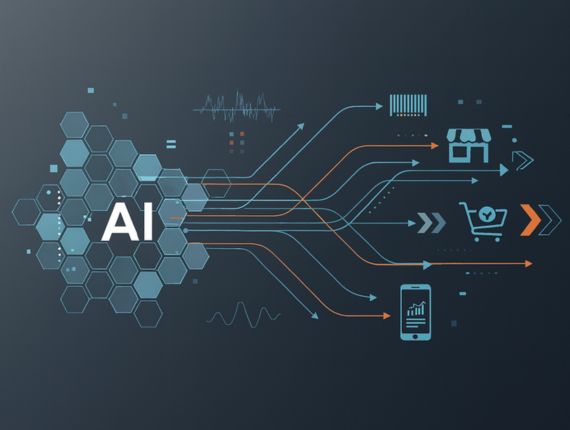
Artificial Intelligence has become one of the key driving forces behind the transformation of modern retail and the FMCG sector. Until recently, AI-based solutions were primarily associated with experimental projects. Today, they are strategic initiatives, enabling retailers, among other things, to better manage inventory and personalize customer interactions on an unprecedented scale.
The interest in AI-based solutions within the retail industry is immense. According to forecasts from the global research firm IDC (“FutureScape: Worldwide Retail 2024 Predictions”), up to 95% of retailers plan to test or deploy generative AI in their businesses in the coming years. Furthermore, McKinsey analysis indicates that the potential added value of AI for the retail and FMCG sectors could range from $240 to $390 billion annually.
Studies also show that personalized product recommendations can boost purchase conversion by up to 20%, and computer vision systems can reduce issues with self-checkout registers by over 70%. At the same time, full-scale AI implementation remains a challenge for many companies. The most common barriers are data-related issues (quality, consistency, and availability) and a lack of appropriate employee competencies.
Key trends in AI utilization in retail and FMCG
Several key trends are being driven by Artificial Intelligence solutions in the retail and FMCG sectors:
Mass-Scale Personalization – thanks to AI, retailers can create dynamic product recommendations tailored to individual customer preferences, resulting in higher sales and greater buyer loyalty.
AI-Powered Customer Service – chatbots and virtual assistants based on Large Language Models (LLMs) are increasingly becoming the first line of customer contact. They automate the handling of inquiries, complaints, and advice, enhancing both speed and quality.
Autonomous Stores and Computer Vision – real-time image analysis (computer vision) helps eliminate out-of-stock issues on shelves and improves the efficiency of self-checkout systems. It also allows for the creation of queue-free stores, where customers simply pick up goods and leave, with the system automatically charging them.
Redefinition of Operational Processes – The use of AI mandates organizational changes and a culture of continuous experimentation. Companies must redesign many business processes to fully harness the potential of AI (e.g., supply chain management based on AI predictions). AI-Ready Infrastructure – The success of AI implementations depends on solid technological foundations: high-quality data, appropriate cloud architecture, and secure, high-performance networks.
Examples of AI Implementations in Retail
An increasing number of companies in the retail and FMCG sectors are already implementing AI-based solutions, achieving measurable benefits. Here are a few examples:
Hypermarket Chain in Asia – an Asian retail chain executed a computer vision system project to monitor shelves and self-checkout registers. The result includes a 15% reduction in out-of-stock items on shelves and a 70% decrease in self-checkout incidents, leading to higher customer satisfaction and increased sales.
Sensei Autonomous Stores – The Portuguese startup Sensei has launched stores where customers do not need to approach checkouts. They simply take the products and walk out, with the system automatically charging the due amount with over 99% accuracy. This innovation eliminates queues and saves the network owner on operating costs.
FMCG Manufacturer from Central Europe – A consumer goods company wanted to implement advanced personalization but lacked in-house AI experts. The solution was to engage an external company – after workshops with their specialists and the implementation of a ready-made platform, a recommendation system was launched within six months. The result was an 18% increase in online sales in the first quarter of its operation.
Barriers to AI Implementation
Despite successful pilot projects, many companies face difficulties in transitioning AI solutions from the testing phase to everyday, wide-scale use. The most common barriers include:
Competency Gap – up to 44% of managers point to a lack of AI specialists within the organization as the main obstacle to implementation (according to a Futurum Group study).
Data Challenges – data required for training models are often collected in non-uniform formats and dispersed across different departments and systems, hindering their effective use. IT teams must spend weeks on proper preparation. Without data centralization and standardization, AI projects will not deliver the expected benefits.
Costs and Infrastructure Complexity – Building a proprietary AI infrastructure can be time-consuming and very costly. Investment is required in hardware, software, data management, and integration tools, as well as ensuring security – for many retailers, this is an insurmountable barrier without external support.
To overcome these challenges, companies are increasingly turning to specialized technology providers. Their support often extends beyond offering comprehensive solutions to include consulting and training, enabling employees to acquire the necessary competencies for independent AI project development.
Development prospects for AI in retail
The future of retail involves the increasingly deep integration of the physical and digital worlds – the concept of phygital retail is taking real shape thanks to AI. AI-based solutions allow combining the convenience of online shopping with the engaging experience known from physical stores. Today, we encounter cashierless stores, which were considered a futuristic experiment until recently, but are now becoming standard in some cities.
In the coming years, we can expect the widespread adoption of agentive and multimodal AI systems capable of simultaneously analyzing different types of data (text, image, sound, or IoT signals). This will enable even more accurate demand forecasting, dynamic pricing management, and near-full automation of store operations – from inventory replenishment to real-time personalized customer service.
Experts predict that within the next 5–10 years, AI will become just as indispensable to retailers’ operations as ERP or CRM systems. Companies that begin their transformation based on Artificial Intelligence now will become leaders of change and gain a competitive advantage.
This article is based on the publication “From data to decisions: AI in retail and FMCG” prepared by the HandelExtra in collaboration with HPE and Nvidia.